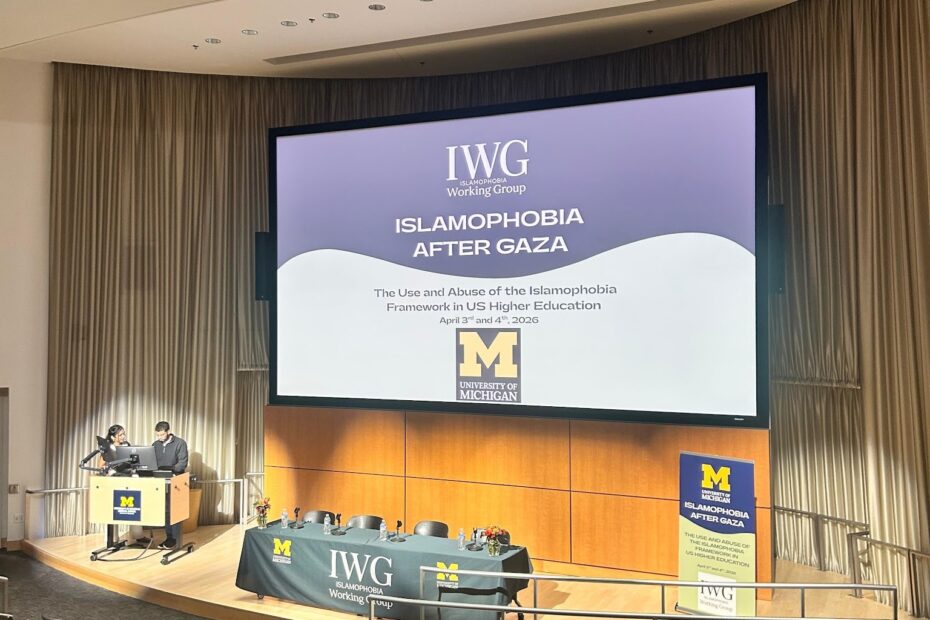
Attending the Islamophobia Working Group Conference at the University of Michigan
From April 2–4, 2026, Muslim Campus Life attended the Islamophobia Working Group Conference at University of Michigan. The conference centered on the theme “Islamophobia After Gaza: The Use and Abuse of the Islamophobia Framework in U.S. Higher Education,” bringing together scholars and practitioners to critically examine how Islamophobia is understood and addressed within academic spaces.
Engaging Critical Conversations
Over the course of the conference, sessions explored:
- Islamophobia in U.S. higher education in the aftermath of Gaza
- The use—and misuse—of the Islamophobia framework in institutional and academic contexts
Discussions highlighted how frameworks of Islamophobia can, at times, be detached from broader systems such as colonialism and racial capitalism. Participants were challenged to consider whether current approaches meaningfully reflect lived realities or risk being reduced to surface-level diversity narratives.
Key reflections emphasized:
- The importance of grounding scholarship in community realities
- The need to move beyond diluted, institutionalized approaches to inclusion
- Centering voices and experiences that are often marginalized
- Aligning academic work with principles of justice and accountability
Muslim Campus Life’s Presence
Muslim Campus Life attended the conference as part of its ongoing commitment to engaging deeply with issues that impact Muslim students in higher education.
As conversations around Islamophobia continue to evolve, participating in spaces like this allows us to both contribute to and learn from critical discourse while bringing these insights back into our work supporting Muslim campus communities.
The Islamophobia Working Group Conference served as an important space for reflection and re-evaluation, encouraging more honest, nuanced, and community-centered approaches to understanding Islamophobia.
For Muslim Campus Life, this engagement reinforces the importance of bridging scholarship and practice, ensuring that efforts to address Islamophobia remain grounded in both critical analysis and lived experience.